
What Your Employees Are Actually Doing Every Day

What Your Employees Are Actually Doing Every Day
I read that some of the big AI players are sending their engineers into companies to help them speed up their AI adoption. For leaders in a hurry, this sounds promising. As someone who has worked side by side with tech folks for more than four decades, I imagine some awkward moments.
Software developers have their own unique way of thinking about how customers do work every day. I remember years ago reviewing the new features for the insurance company software we were building. It quickly became clear that requirements and implementation had parted ways.
When I asked Brenda, one of our developers, why a feature didn't work the way we described, she dismissed me with a flick of her hand and the memorable, “It’s working as implemented.”
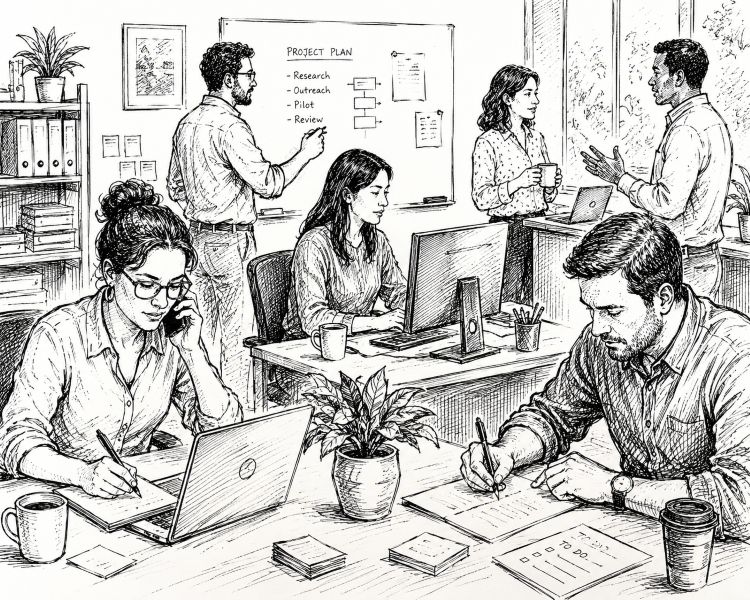
I’ve been thinking about the imperfect advice we’re being given. For most of us who are trying to find some way through the do-more-faster pressure, this approach is calming — automate the visible, simple tasks that you do every day. That makes some sense as a starting point. But what this jumps over is what we’ve talked about before – the human things that happen between begin and end.
My friend Jose figured that out. At first, he considered automating email responses to potential clients’ inquiry messages. But then he stopped and thought about what really happened after he listened to their message.
He didn’t send an email. He talked to them. He asked more questions. He took the time to understand what this person really needed, not necessarily what their message said. It wasn’t a generic request that a canned response would satisfy yet.
I wonder how many of these AI engineers have been trained to notice how work really moves through a company. It’s all of those unseen things that people do between start and end that we risk sacrificing for speed.
Things like:
- calming a frustrated customer,
- noticing when something feels off,
- catching a mistake before it spreads,
- clearing up misunderstandings among the team,
- adjusting communication based on personality,
- sensing risk early,
- helping work continue when the normal process breaks.
It’s easy to measure and reward the results we can see. What we don’t always see are the everyday activities that happen along the way.
Who doesn’t love the aroma of a pie fresh from the oven? But do we really think about who made sure the cherries were pit-free? Before we rush to flatten work for the sake of easy automation, we need to spend more time understanding the middle.
Employees are expected to be good communicators without being shown how to do it. Unless they are in leadership, sales, or marketing, writing and speaking well are rarely actively taught. Employees are expected to do the work, move fast, answer quickly, and solve problems.
Few companies help employees become clearer explainers, contextual thinkers, or thoughtful communicators. As a result, they often don’t have the confidence and skills to highlight the important things they do every day.
The irony is that work increasingly depends on these communication abilities. It’s especially true as AI becomes more woven into our everyday work. The quality of our AI interactions relies on clear context, well-written prompts, explaining nuance, and intent.
Encouraging storytelling gives employees a comfortable space to develop their observation, clarity, what-if, analytic, and critical thinking skills. A lot of folks have expertise they’ve never learned how to put into words.
They know:
- something feels inefficient,
- customers react differently depending on the circumstance,
- confusion keeps happening in a given situation,
- or certain work only succeeds because of hidden coordination.
Everyone feels seen and appreciated when they’re asked to share what they know. They gain the confidence to simply say, “I noticed this, and here’s what I did next.” Before we rush to hand over those simple tasks to AI, ask the people who do the work what it really looks like. Where are the places where their human judgment and experience play a part in the outcome.
The Bottom Line
Like Jose’s healthy pause, understanding how work moves shapes our decisions more than we often realize. We give ourselves the mental space to ask how, when, and if AI is the right tool for each job.
“Working as implemented” becomes implemented the way we’re working.
One thing you can think about this week. What would stop working if your most observant employee wasn’t there tomorrow?
How Work Happens Here
Before you decide what to do with AI, see the work people do every day. What happens between start and end is the important middle.
Then decide what's right for your company.
Explore How Work Happens Here
 Linda Rolf is a lifelong curious learner who believes a knowledge-first approach builds valuable, lasting client relationships.
 She loves discovering the unexpected connections among technology, data, information, people and process. For more than four decades, Linda and Quest Technology Group have been their clients' trusted advisor and strategic partner.
Tags: